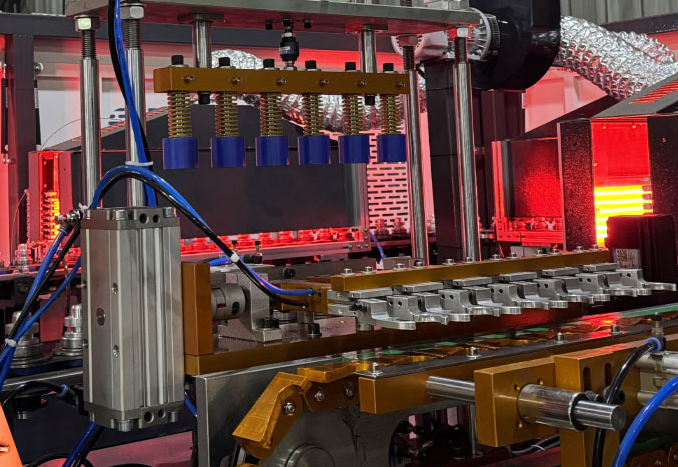
On a high-speed blow molding line, the heating stage is where you make or lose money. Preforms that run too cool give you weak bottles and a pile of scrap. Run them too hot, and you get crystallization, haze, plus a heating tunnel that never stops chasing setpoints. When the heater can’t keep up, the whole line has to slow down just to compensate. We built our high-speed blow molding heater line around one practical demand: drop-in performance on the machines you already run. Sidel, Krones, SIPA, Husky, SACMI, Nissei ASB—whatever you have, the heater has to match the OEM electrical and thermal specs so the existing control logic and process windows stay intact.
What actually matters, technically
This isn’t a generic infrared module you bolt in and hope for the best. It’s a machine-matched heating component, engineered for stretch blow molding duty. In this business, repeatability and fast thermal response beat raw wattage every time. We stick with short-wave infrared halogen emitters in quartz tubes because they give you rapid rise time and fast cooling—exactly what you need when preforms are flying through a high-speed heating tunnel and the dwell time per zone is tight. The tungsten filament inside a clear quartz envelope produces a tight, controllable spectral output that couples cleanly into PET, so you get consistent surface heating and predictable through-thickness behavior. The details that matter on the floor boil down to matching the numbers your machine was designed around:
- Power density and wattage: We match the OEM wattage per emitter and per zone so the total heat input to the preform doesn’t change. On Sidel SBO and SBO2 series, for example, we supply emitters sized to the original per-zone wattage so the heating curve stays stable without re-tuning the recipe.
- Voltage and current: We provide voltage options that line up with the original heaters—commonly 100–240 V configurations—so your transformers, power wiring, and contactors don’t need redesign.
- Emitter geometry and mounting: Quartz tube length, end cap style, and overall envelope match the OEM footprint. That includes standard R7s-style connections and the same overall length, so the emitter drops into the same brackets and reflectors.
- Thermal profile control: The heater is built to deliver repeatable output across the entire active length. Preform heating is a function of distance, time, and irradiance. If the output drifts along the tube, you get banded heating and uneven stretch behavior.
- Connector and termination: We match the termination method the original equipment uses, including connector type and polarity. That cuts down on wiring mistakes during changeover and keeps commissioning short.
- Control compatibility: Heater resistance and thermal behavior are matched to the OEM spec so your existing PID or power controller tuning stays valid. You shouldn’t have to re-learn the heating curve just because the heater is new.
Why this works where it counts
Out on the blow molding floor, the heater has to do three things at once: keep pace with cycle time, hold a tight temperature band, and survive the environment. Speed first. In high-speed stretch blow molding, preforms move through the heating tunnel fast. The emitter has to hit setpoint quickly and recover immediately after each shot. Short-wave halogen emitters respond fast because the filament heats and cools with low thermal inertia. Less time spent correcting temperature means more consistent heating from preform to preform. Then quality. Uneven heating shows up as wall thickness variation, weak shoulders, and inconsistent bottle finish. When the heater matches OEM parameters, irradiance distribution and zone balance stay the same, so the preform temperature band tightens. The payoff is fewer scrap bottles and less variability downstream in filling and packing. And uptime. Heaters are a maintenance item, and downtime is expensive. We design the tube and termination for the reality of the tunnel—high heat, vibration, and frequent changeovers. In practice, many of our units run 5,000+ hours while keeping output stable enough to hold the heating window. When you do need to swap one, the 1:1 mounting and wiring match means the changeover is quick. This matters even more when you run a mixed fleet. If your plant has Sidel, Krones, SIPA, Husky, SACMI, and Nissei ASB machines, you don’t want a different engineering approach for each brand. You want a single replacement strategy that respects each machine’s original spec. We provide heaters matched to each platform so you can standardize spares without sacrificing performance.
What you need to know on the floor
Even a drop-in heater needs a clean interface to do its job. Installation goes smoothly when the reflector is in good shape and the mounting hardware is correct. If the reflector is oxidized or warped, the new emitter will run hotter than intended and the heating profile can drift. Replace or recondition reflectors as needed, and check alignment so the emitter sits in the same focal plane as the original. Electrically, make sure the supply matches the heater rating. Running a 230 V emitter on a 120 V circuit—or vice versa—will change the output and shorten life. Confirm connector orientation and contact condition; loose or pitted contacts cause voltage drop, which shows up as lower output and inconsistent heating. Environment counts. Keep the emitter surface free of dust, oil, and preform debris. A contaminated tube runs hotter locally, which accelerates end-of-life and can create hot spots in the heating profile. In humid environments, make sure the termination area stays dry and the wiring path doesn’t let condensation reach the terminals. And don’t assume a longer tube is better. If you change the envelope length without adjusting the whole heating zone, you alter irradiance distribution and can push the preform outside its optimal window. Match the original geometry first; optimize later, if you even need to. If your line is running at high speed and the heating stage is the bottleneck, start with the heater that matches the machine spec. Match the wattage, match the geometry, match the connections, and you get the heating behavior the blow molder was designed for—without re-engineering the process.